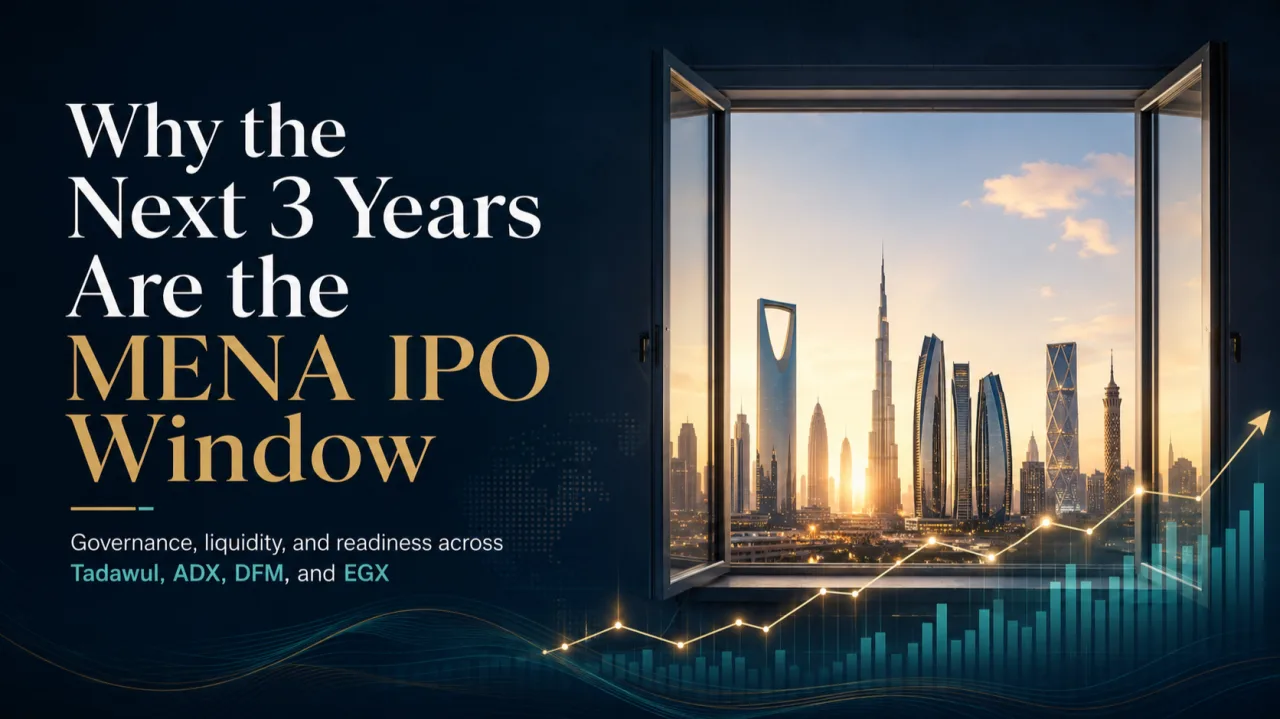
Why the next 3 years are the MENA IPO window
In every one of those seats, I have watched founders and family shareholders treat an IPO as a financing event. It is a governance event that happens to end with a financing event.
I have spent the better part of 18 years moving between private equity, venture capital, turnaround management, and now M&A advisory across the US, Europe, and MENA. In every one of those seats, I have watched founders and family shareholders treat an IPO as a financing event. It is not. It is a governance event that happens to end with a financing event. Everything that goes wrong in a listing process, every delay, every withdrawn prospectus, every down round at pricing, traces back to that misunderstanding.
That confusion is the single biggest reason regional companies miss their listing window. And the window that is open right now, across Tadawul, ADX, DFM, and increasingly EGX, will not stay open indefinitely. This article lays out why the timing matters, what is actually driving the liquidity, and why three years, not one, is the honest runway for a family or founder led business to get ready.
The liquidity case, market by market
Saudi Arabia. Tadawul has spent years building a pipeline anchored by the Kingdom's privatization program. The numbers back this up. Saudi Arabia raised $4.1 billion in IPO proceeds in 2025, roughly 79 percent of total GCC proceeds for the year, according to Kuwait Financial Center (Markaz). The Saudi Exchange hosted 13 IPOs on its main market worth $3.7 billion, while the Nomu parallel market added another 23 offerings worth $336 million, meaning a company too small for the main board still has a credible listing path. The pipeline behind those numbers is even more telling than the numbers themselves: the Saudi Exchange CEO said in December 2025 that around 40 companies currently have listing applications under review by the regulator, and that a further 80 to 100 companies have already engaged an advisor or lead manager to begin preparing. That is not a market waiting for deal flow. It is a market with more issuers lining up than the pipeline can currently absorb in any given year, which is exactly the kind of competitive environment where being ready early matters most. Underpinning all of it are two distinct Vision 2030 targets worth separating: one on stock market size, growing the market to roughly 88 percent of GDP excluding Aramco by the end of the decade, up from 87 percent at the end of 2024, and a separate, broader target of lifting the private sector's overall contribution to GDP to 65 percent. Every successful large cap listing makes the next mid cap listing easier to price, because the analyst coverage, the institutional familiarity, and the retail appetite are already primed. That is a compounding effect, and it favors companies that show up while the momentum is still building rather than after it has already been captured by the first wave of issuers.
UAE. Abu Dhabi and Dubai have spent the last several years converting family and government linked IPOs into a genuine track record, and the scale is now real. ADX closed 2025 at roughly AED 3.1 trillion in market capitalization, about $850 billion, making it the largest of the UAE's three exchanges, while DFM's market cap stood near $244 billion as of March 2025 across close to 70 listed companies. 2022 was the breakout year for UAE IPOs, with 11 listings raising $13 billion, and 2024 saw a second wave: Talabat's $2 billion DFM listing and Lulu Retail's ADX debut together accounted for roughly half of that year's total UAE IPO proceeds, alongside NMDC Energy, ADNH Catering, Agility Global, Alef Education, Parkin, and Spinneys. 2025 opened more modestly, with Alpha Data's $163 million ADX listing in March as the first UAE IPO of the year, a reminder that these windows move in cycles rather than a straight line upward. Investors who were skeptical five years ago are now allocating meaningfully to UAE equities, and the free float available to absorb new issuance has grown alongside that shift in sentiment. The UAE's regulatory environment, spanning the mainland Securities and Commodities Authority alongside ADGM and DFSA in the free zones, has also become more predictable, which matters enormously to institutional investors who price regulatory uncertainty into every allocation decision.
Egypt. EGX has spent a decade trying to reverse a wave of delistings and persistently thin trading volumes, and the state's response has become concrete rather than aspirational. The government's IPO program, first launched in 2016, currently has 20 state-owned companies temporarily listed on EGX and working through preparation requirements. In July 2026 the Financial Regulatory Authority launched the country's first national IPO readiness training program, with the first seven-day cohort running executives, CFOs, and board members from 14 of those 20 companies through disclosure, governance, and prospectus preparation, with the remaining companies and other state-owned enterprises expected to follow. Misr Life Insurance, holding roughly a 22 percent share of Egypt's life insurance market with shareholders' equity of about EGP 42 billion as of September 2025, is one of the names moving through this pipeline, with EFG Hermes mandated to lead a planned offering of around 20 percent of the company. In the third quarter of 2025 alone, Egypt contributed two IPOs, Bonyan for Development and Trade and National Printing Company, to a broader MENA IPO count that EY reported at 11 listings and $700 million raised, a 120 percent increase in listing volume year over year. The state has real incentive, tied to broader capital markets development goals and IMF program commitments, to make the next generation of listings succeed, and that incentive is now showing up in regulatory infrastructure rather than just political statements. Egypt's window is less mature than Saudi's or the UAE's, but that is precisely why the companies that move early stand to benefit from being part of the first credible wave rather than competing in a saturated one.
None of this liquidity sits still. GCC IPO proceeds fell 61 percent in 2025 versus 2024, from $13.2 billion across 53 offerings to $5.1 billion across 40, a reminder that these windows are cyclical and capital rotates toward whoever is ready when conditions turn favorable again. Companies that start preparing today, with a genuine three year runway, are positioning themselves to be the ones capital finds when it arrives. Companies that wait for the window to feel obviously open will be competing with everyone else who had the same idea at the same time, against a market that may have already moved on to the next sector story or the next country story.
The pattern I see most often
Advising family and founder led businesses across the region, the commercial story is usually strong. Revenue growth, margins, market position, all defensible, sometimes genuinely excellent. What is not ready is everything underneath it.
The board is the founder plus relatives, with maybe one long serving executive given a seat as a courtesy. There is no independent director in the room to challenge a related party transaction or ask why the CFO reports informally to the founder's brother rather than through a proper finance function. The financial statements were built for tax efficiency and bank covenant compliance, not investor scrutiny, which means margins are sometimes understated, related entities absorb costs that should sit on the operating company's books, and three clean years of audited financials, the baseline any regulator will ask for, simply do not exist yet. This is exactly the gap Egypt's own FRA training curriculum is now built to close for its state-owned pipeline: financial and accounting readiness, governance and disclosure, and prospectus preparation are treated as a distinct, multi-month workstream, not a checklist item.
Related party transactions run through the group in ways that made sense internally for twenty years. Shared services, intercompany loans, real estate leased from a family holding company at below market rates, supply arrangements with a cousin's trading business. All of it is normal in a private group structure. None of it survives a prospectus disclosure section without extensive unwinding, and unwinding it takes time because you are not just changing paperwork, you are renegotiating real commercial relationships that the family has depended on for decades.
There is no CFO who has ever answered to public shareholders, because there have never been any. The finance team is excellent at managing cash and relationships with local banks. It has never built a quarterly reporting cycle for institutional investors, never fielded a call from a sell side analyst, never had to explain a variance to a board committee that includes someone with no family loyalty and no patience for a vague answer.
None of that is fixable in six months. Governance restructuring, audit trail rebuilding, related party unwinding, and finding or developing the right CFO all take real time, and each of those workstreams tends to surface problems that take even more time to fix once you find them. You do not know how deep the related party unwinding needs to go until you are two years into the process and discover a leasing arrangement nobody flagged at the outset. You do not know the audit will require restating two prior years until the auditors are six months into the engagement. That is the three year logic. It is not a marketing number chosen because it sounds credible. It is roughly how long it takes to do the work properly without the deadline forcing shortcuts that a regulator or an underwriter's legal counsel will catch later, at a much worse moment, with much worse consequences.
Why waiting is more expensive than it looks
The cost of starting late is not linear. A company that begins governance and financial cleanup with eighteen months left before a target listing date is not simply doing the same work faster. It is doing the work under pressure that forces bad tradeoffs. Boards get assembled quickly with whoever is available rather than who is right. Audits get compressed in ways that increase the risk of restatements. Related party unwinds get negotiated under time pressure, which weakens the family's negotiating position with its own group entities and can leave value on the table that a calmer, earlier process would have preserved.
There is also a market timing cost that is easy to underestimate, and the 2025 numbers illustrate it directly. GCC issuers who priced in 2024, when $13.2 billion moved through 53 offerings, priced into a materially stronger market than issuers competing for the same investor attention in 2025's $5.1 billion pool. Regional IPO windows have historically opened and closed based on macro sentiment, oil price cycles, and regional political risk perception, sometimes with only a few quarters of genuine window before conditions shift. A company that is only IPO ready when the window is already wide open has, by definition, missed the earliest and often best pricing conditions within that window, because the earliest issuers in any cycle tend to capture the most investor enthusiasm and the most favorable multiples before the market becomes more discerning about the later entrants.
The optionality argument
The other reason to start now, even for founders who are not fully committed to a public listing, is optionality. A company that becomes IPO ready does not have to IPO. It becomes a more attractive acquisition target, because acquirers doing diligence on a well governed company with clean financials and no related party overhang move faster and pay more confidently than they do on a family business with none of that in place. It becomes a stronger counterparty for private credit, because lenders underwrite governance and reporting quality as much as they underwrite the business model itself. And it becomes a business that institutional investors, whether through a pre IPO round, a strategic minority stake, or a private equity partnership, can actually underwrite, even if the founder decides to stay private for another five or ten years. Saudi Arabia's Shareek program, under which Aramco, SABIC, STC, and other leading companies have committed roughly SAR 5 trillion to domestic investment by 2030, is one concrete example of how much private and quasi-private capital is actively looking for well prepared counterparties across the region right now, not only through public listings.
I have advised on transactions where the real value of the preparation work showed up not in a listing at all, but in a private sale process or a strategic investment that moved faster and priced better because the buyer's diligence team found a clean, well governed company instead of a family business dressed up for a pitch. IPO readiness, in other words, is a form of insurance on every other strategic option a founder might eventually want to exercise.
What this means for the next three years
The founders who treat the next three years as a runway, rather than a deadline, are the ones who end up with real choices when the window is at its widest, whether that choice is a Tadawul, ADX, DFM, or EGX listing, a private sale, or simply the ability to raise growth capital on better terms than a family business without the same governance and reporting maturity could command. The ones who wait for certainty, who decide to start preparing only once the market signal is unmistakable, will be preparing at the same time as everyone else, competing for the same bankers, the same auditors, and the same investor attention, with a lot less room to fix what diligence turns up before the window moves on.
In the next article in this series, I will get into the part most advisors underplay because it is the most uncomfortable conversation to have with a founder: governance. Specifically, why separating ownership from management is the hardest and most necessary step for a family business preparing to go public, and why succession planning and IPO readiness are, in practice, the same conversation, whether the founder wants them to be or not.
Sources: Kuwait Financial Center (Markaz) GCC IPO reports 2025; PwC Middle East Q3 2025 GCC IPO Watch; EY MENA IPO Eye Q3 2025; AGBI reporting on Saudi Exchange pipeline (December 2025); Vision2030.ai and Saudipedia on the National Privatization Strategy and Vision 2030 targets; Ahram Online, Arab Finance, and Zawya reporting on Egypt's FRA IPO readiness program; Aurora50 and Wikipedia on UAE exchange data.
Published in
For institutional and professional investors. Not investment advice.
Eighteen years in investment management, M&A and financial technology. A CFA Charterholder, he leads investment analysis, valuation and fund structuring across Significa's advisory and investment practices, and teaches valuation and fund structures in the CVC Builder curriculum. Concurrently Chief M&A and Growth Officer at AlternativeSoft in London; co-founder of MarkeScope, which developed the first stock-screening solution to incorporate risk measures. Treasurer of CFA Society Egypt; BSc Electrical, Electronics and Communications Engineering, Cairo University.