
Yesterday’s 25 bp Fed hike reinforces a difficult global macro backdrop
Yesterday’s 25 bp Fed hike reinforces a difficult global macro backdrop: resilient US growth, persistent inflation and a higher cost of capital.

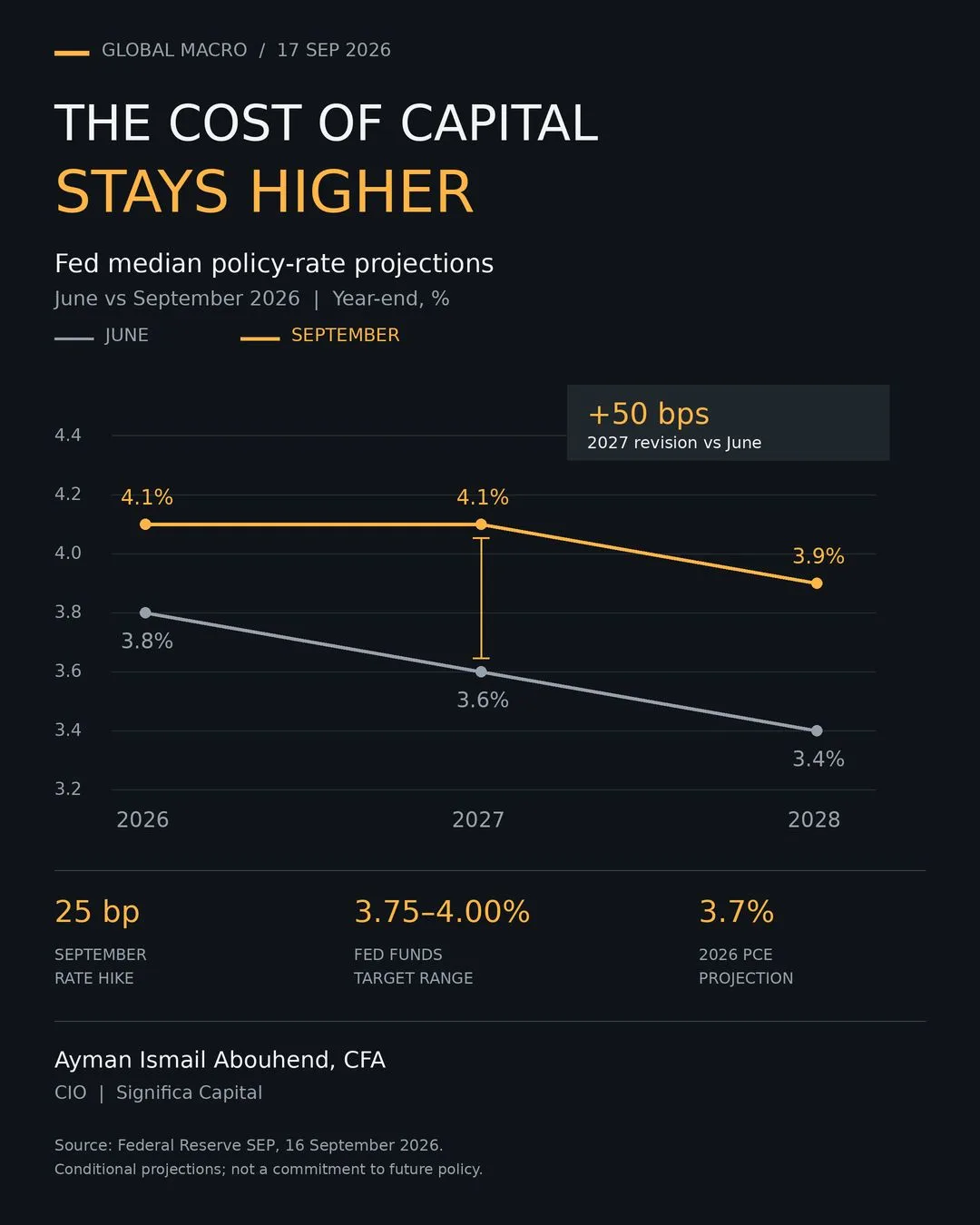
Yesterday’s (as expected, don't act as if you were surprised!) 25 bp Fed hike reinforces a difficult global macro backdrop: resilient US growth, persistent inflation and a higher cost of capital.
The target range now stands at 3.75–4.00%. The more consequential signal is the projected policy path: the median year-end rate is 4.1% for both 2026 and 2027, versus June projections of 3.8% and 3.6%, respectively.
These are conditional projections, but they materially challenge the assumption of near-term monetary relief. Fed projections
From an Investment persona perspective, three implications stand out.
-
Duration requires a stronger underwriting case: The Fed projects 2026 GDP growth of 2.3%, unemployment of 4.1% and PCE inflation of 3.7%. That combination gives policymakers room to sustain restraint. Long-duration assets remain exposed if discount rates stay elevated (an event that I expect to happen) while earnings expectations soften. Economic projections
-
Emerging-market carry must compensate for currency risk: The hike was already heavily priced: markets assigned approximately 95% probability before the announcement, while the US 10-year yield had traded above 5%. Some tightening therefore, already, preceded the decision. For EM allocations, the relevant test is net carry after funding costs, taxes and expected FX depreciation, with adequate compensation for liquidity and sovereign risk. A wide nominal spread alone is insufficient. Pre-decision pricing and still will mature in the coming period.
-
Refinancing assumptions deserve renewed scrutiny: For leveraged businesses and sovereigns, higher rates transmit through maturity walls, floating-rate exposure and weaker debt-service coverage. In private markets, I would place greater weight on free-cash-flow conversion, pricing power and deleveraging capacity, while stress-testing exit multiples and refinancing spreads.
The impact will also differ across economies. Energy importers face pressure on both margins and external balances; exporters may gain fiscal capacity, although regional disruption can offset that benefit. This is very critical.
My investment bias is toward liquidity, resilient balance sheets and returns supported by operating cash flows. Any thesis that requires cheaper refinancing or multiple expansion to deliver its target IRR now needs a wider margin of safety.
Published in
Eighteen years in investment management, M&A and financial technology. A CFA Charterholder, he leads investment analysis, valuation and fund structuring across Significa's advisory and investment practices, and teaches valuation and fund structures in the CVC Builder curriculum. Concurrently Chief M&A and Growth Officer at AlternativeSoft in London; co-founder of MarkeScope, which developed the first stock-screening solution to incorporate risk measures. Treasurer of CFA Society Egypt; BSc Electrical, Electronics and Communications Engineering, Cairo University.