
Initial commentary on the EA Games acquisition: an LBO case analysis
I’ve been discussing with peers the idea that debt-laden acquisitions can absolutely happen in the tech sector, under the right conditions. The key hinges are ARR (Annual Recurring Revenue) and AROI (Annual Recurring Operating Income), which serve as stabilizers in volatile industries.

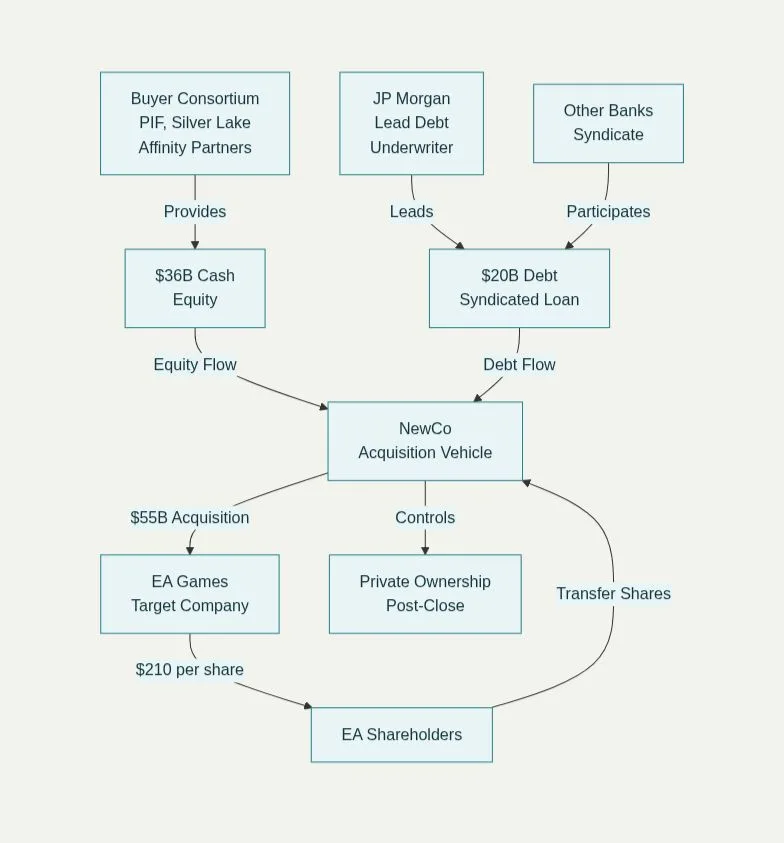
I’ve been discussing with peers the idea that debt-laden acquisitions can absolutely happen in the tech sector, under the right conditions. The key hinges are ARR (Annual Recurring Revenue) and AROI (Annual Recurring Operating Income), which serve as stabilizers in volatile industries.
That said, this is not a classic LBO. The equity contribution here is roughly 66%, higher than the typical ~50% we usually see in leveraged buyouts. This alone changes the risk/return architecture of the deal.
Another point: the acquisition is strategic more than financial. The transaction is priced at 20–24x EBITDA, while the market range for gaming assets sits closer to 10–12x. The exception is Microsoft’s Activision deal—also expensive, but backed by clear platform synergies that created outsized free cash flow value. EA doesn’t enjoy the same platform hedge.
On the financing side, the $20bn in debt is notable. With a single-B rating, we’re talking about an average cost of $1.8–2bn repayment through 2030 (before any re-IPO). That exit will be critical: unless the sponsors can sell back into the market at the same entry multiple, the IRR profile could collapse.
Finally, cost cutting looks unlikely here. In fact, capex (currently ~$200m annually) will likely need to rise to sustain competitiveness in a crowded gaming ecosystem. That means value creation will rely less on margin efficiency, and more on maintaining EV north of $55bn while steadily reducing leverage.
I will add an article on the financial analysis of the deal but thought to place some points of the tip of my mind here.
Published in
Eighteen years in investment management, M&A and financial technology. A CFA Charterholder, he leads investment analysis, valuation and fund structuring across Significa's advisory and investment practices, and teaches valuation and fund structures in the CVC Builder curriculum. Concurrently Chief M&A and Growth Officer at AlternativeSoft in London; co-founder of MarkeScope, which developed the first stock-screening solution to incorporate risk measures. Treasurer of CFA Society Egypt; BSc Electrical, Electronics and Communications Engineering, Cairo University.