
There’s a disconnect in the market that most people are underestimating
There’s a disconnect in the market that most people are underestimating. The US 10Y–2Y yield curve has been inverted for over two years now, a classic late-cycle signal.

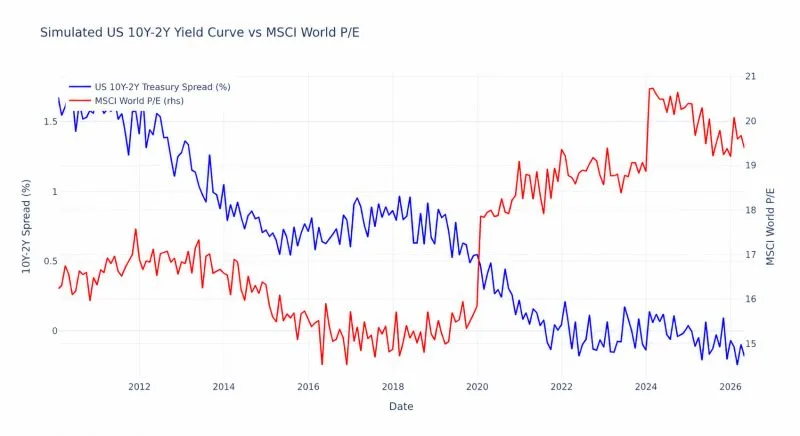
The US 10Y–2Y yield curve has been inverted for over two years now, a classic late-cycle signal. Yet global equities are still trading at elevated multiples, with MSCI World P/E hovering in the ~19–21x range. That’s not how the economic engine works.
What we are seeing is a shift away from purely macro-driven valuation frameworks. In layman terms, Liquidity, AI-driven narratives, and passive flows are playing a much larger role in sustaining and pushing valuations, even as traditional signals point toward economic slowdown.
The result is a two opposite torn market. High-quality, narrative-driven assets in sectors like AI, healthcare, and infrastructure technology continue to command premium multiples, often dominated by strategic buyers. Meanwhile, the rest of the market is facing valuation pressure, liquidity constraints, and an increasing number of reluctant or forced sellers.
In this environment, traditional multiple arbitrage is no longer a viable strategy. The playbook of buying at 8x and exiting at 12x has structurally weakened. Value creation is shifting toward proprietary sourcing, operational execution, and real synergy capture. Platform building is replacing portfolio assembly.
At the same time, the yield curve remains a leading indicator. Historically, inversion precedes real economic dislocation by 12 to 24 months. We are now entering that phase. This will likely open up a window for more opportunistic transactions, particularly in carve-outs, distressed growth situations, and founder-led liquidity events.
Capital structure is becoming a core differentiator. With elevated rates and tighter financing conditions, traditional leveraged buyouts are under pressure. In their place, we are seeing increased use of private credit, structured equity, earn-outs, and minority-to-control strategies. The ability to structure a deal creatively is now as important as identifying the right asset.
Strategic buyers are also regaining an edge. Corporates with strong balance sheets and cash flow visibility can move faster, rely less on external financing, and justify paying a premium through synergies. In many cases, they are now outcompeting financial sponsors.
The biggest risk in this market is waiting for multiples to correct. They may eventually adjust, but the repricing is unlikely to be gradual. When it comes, it will be sharp, and those who are not positioned will miss the opportunity.
The bottom line is clear. This is not a wait-and-see environment. It is a market that rewards selective aggression. The priority now is to build pipeline, deepen conviction, and be ready to execute into dislocation — particularly in situations where complexity, structure, or access create an edge.
Published in
Eighteen years in investment management, M&A and financial technology. A CFA Charterholder, he leads investment analysis, valuation and fund structuring across Significa's advisory and investment practices, and teaches valuation and fund structures in the CVC Builder curriculum. Concurrently Chief M&A and Growth Officer at AlternativeSoft in London; co-founder of MarkeScope, which developed the first stock-screening solution to incorporate risk measures. Treasurer of CFA Society Egypt; BSc Electrical, Electronics and Communications Engineering, Cairo University.